Thursday, January 20, 2011

a new direction

I'm not entirely sure anyone reads this anymore, given that I did a terrible job continuing posting as I traveled around China. In my defense, Internet was very limited and somehow it just didn't seem as exciting to post months later about the funky tofu I got from that street vendor or the ancient Tibetan cowboy who tried first to grope me and then feed me yogurt....

In any case, this blog is taking yet another new direction as I finish up my master's and make the transition to a doctoral program, wherever it is that I end up. One of the things I spent a great deal thinking about in China is the concept of amor fati, which is a Nietzchen concept meaning "love of fate." The essential idea is to find the beauty and truth in everything--the good, the bad, the ugly. To find a little joy even in the mundane. I realized: I don't need to travel around the world to find something beautiful meaningful. All I need to do is open my eyes now and then and see what is around me. So often we all run around from activity to activity without pausing to appreciate the the icicles on the awnings, the steaming mug of tea, the new stash of Post-Its in the office cupboard. So from here on out, I'm going to post a little something that makes me happy, if for no other reason than to...well, make me happy. 

To begin, the poem that inspired it all:

Amor Fati

Everywhere I look I see my fate.
In the subway. In a stone.
On the curb where people wait for the bus in the rain.
In a cloud. In a glass of wine.

When I go for a walk in the park it's a sycamore leaf.
At the office, a dull pencil.
In the window of Woolworth's my fate looks back at me
through the shrewd eyes of a dusty parakeet.

Scrap of newspaper, dime in a handful of change,
down what busy street do you hurry this morning,
an overcoat among overcoats,

with a train to catch, a datebook full of appointments?
If I called you by my name would you turn around
or vanish round the corner,
leaving a faint odor of orange-flower water,
tobacco, twilight, snow? 

I love Katha Pollit: her poetry is so simple, yet elegant and poignant. I wish I could write with such clarity! I love the possibility of this poem: the idea of finding joy in the grayness of a subway stop, of the humanity of people pressed together in the cold on their morning commute, of a solitary glass of wine, of a mysterious stranger passing by. 

Friday, August 27, 2010

laos part three: the quarter-century mark

I want to write about the most perfect day while it is still fresh in my mind. This morning, Ana and I grabbed a quick Lao coffee-to-go and hopped in a van through the rolling countryside to elephant camp. We cut through the fog blanketing the river in a motorized canoe before and suddenly, there they were. A small herd of elephants, just chomping away. After lots of photo-taking, I scrambled up one of them and took her to the river to bathe. Submerged in the water with Hambi, my elephant, with trunks flying and water spraying everywhere, I felt such  unadulterated joy. Neither Ana nor I could stop laughing--we were like two little girls, chortling with delight. It's been a long time since I've been that happy.

The elephants are both mighty and strangely delicate. You can step and climb on them as you would a ladder or a (very large) stool; their hides are thick and each toenail the size of my foot. Their hair is course like wire and their trunks strong and curious. And yet their eyes are so soulful--expressive and fringed with long lashes--and their ears are soft and exquisite. Riding an bathing elephant with your legs enveloped by its ears is like having your entire lower body embraced by the softest, warmest blanket. 

After the bath, we went to elephant camp, where the animals hungrily tossed back literal tons of grass and bamboo before heading out on a trek through the Lao jungle. We took turns riding in the "chair" atop the elephant and on its neck, with our friendly mahout explaining to us how to tell Hamong to hao (stop), bai bai (go), and san de lai (very good elephant!). 

After our sojourn, we took another van ride to a series of waterfalls, which also strangely turned out to be home to a black bear rehabilitation center. After wolfing down a lunch of fried rice and veggies, we spent the remainder of th eafternoon swimming in a pool of crystalline water. There was a waterfall which I climbed halfway down and just sat in for a solid hour, shivering with pure joy. After about an hour of contemplation, I decided to jump off the falls...and by decided, I should say that two small Lao children tricked me into it because I was too frightened to go alone! Finally, as the sun sunk into its pre-twilight glow, we grabbed a hasty snack of fried coconut before heading off to a local Hmong village. Honestly, I wish we hadn't gone--I felt so touristy and awful traipsing through and snapping photos of napping babies, straw huts, and the public television set in the center of the village. It was so different than the Chinese villages we'd stayed where, although waigouren, we were able to converse and contribute in the local community--or at least to the income of the families we lived with, however briefly. 

Otherwise, it was the perfect start to what hopefully will turn out to be a great year. Here's to a quarter-century!


Ana & I & our Mahout


One of many gorgeous waterfalls


These kids look cute but they were tricky!


Black Bear Stare!

Most adorable Hmong baby


Hmong Village


Finishing off the day with some Lao BBQ!

Monday, August 23, 2010

laos part two

The countryside, from the admittedly limited yet spectacular window of the sleeper bus, is considerably poorer than China. Many houses sit on stilts, with roofs of straw, and in the dusty courtyards you can see very young mothers nursing babies or groups of older women, clad in black sarongs, clustered around a pump for bathing. Luang Prabang is very beautiful, but very touristy--in a "my parents would like this place" sort of way, which I haven't experienced much since arriving in China. It's disorienting to see so many waigouren  (foreigners) in one place; to not be yelled at, "hello! hello!" by young and old men, like little parrots, all the time. The Lao people, from what I can tell, are friendly and soft-spoken; none of the strident tones, spitting, or near-shouting which pepper the language in Kunming.

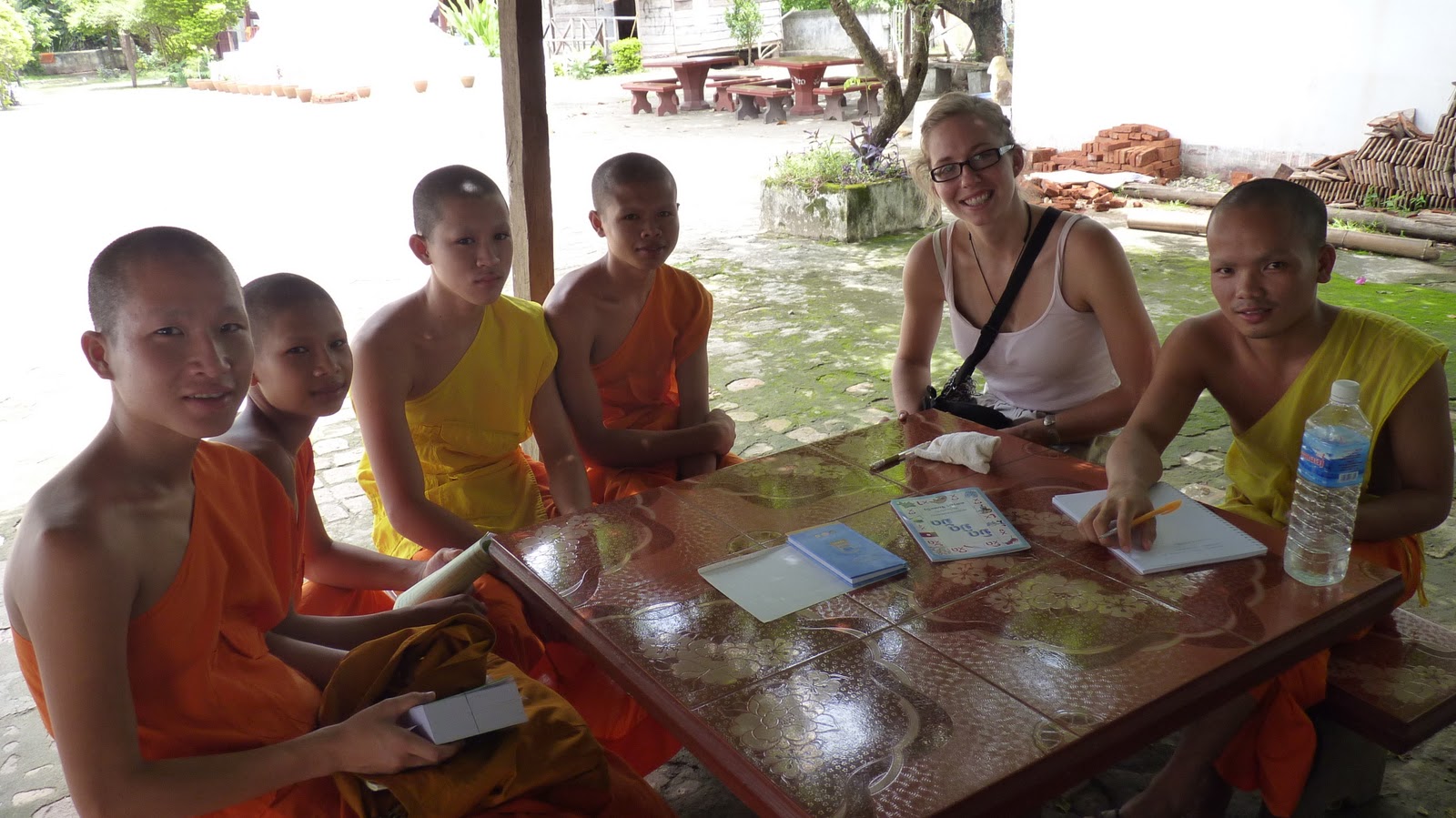
This morning we strolled into a wat, or Buddhist monastery, where a group of young monks and a European couple invited us to sit and practice English with them. We swapped words for trading cards for awhile, learning that several of the monks had come to the monastery at a very young age--fifteen for some. Although sending one child to the monastery is customary for Lao families, I was astonished at the journey these monks--kids, really--had taken. Several were from villages a few hours' bus ride away, which in the Western world is nothing more than a slightly lengthy trip to the local Ikea. But for these young men, life in Luang Prabang is a world away from these tiny mountain villages, from which most of their families will never leave and to where they return but a handful of times. Talking with them, it dawns on me how utterly relative distance is when traveling. I'm reminded of a line from a favorite poem, "The distance is deeper in my heart than miles can show" and just how far away even a blocks can be when something separates you from the people you love. 

Of course, technology can shrink distance...a lesson the monks apparently have learned as well, given they asked me for my name and email so they could "Facebook me." Guess I'd better be a bit more careful about which pictures to post...