Showing posts with label culture. Show all posts

Friday, August 27, 2010

laos part three: the quarter-century mark

I want to write about the most perfect day while it is still fresh in my mind. This morning, Ana and I grabbed a quick Lao coffee-to-go and hopped in a van through the rolling countryside to elephant camp. We cut through the fog blanketing the river in a motorized canoe before and suddenly, there they were. A small herd of elephants, just chomping away. After lots of photo-taking, I scrambled up one of them and took her to the river to bathe. Submerged in the water with Hambi, my elephant, with trunks flying and water spraying everywhere, I felt such  unadulterated joy. Neither Ana nor I could stop laughing--we were like two little girls, chortling with delight. It's been a long time since I've been that happy.

The elephants are both mighty and strangely delicate. You can step and climb on them as you would a ladder or a (very large) stool; their hides are thick and each toenail the size of my foot. Their hair is course like wire and their trunks strong and curious. And yet their eyes are so soulful--expressive and fringed with long lashes--and their ears are soft and exquisite. Riding an bathing elephant with your legs enveloped by its ears is like having your entire lower body embraced by the softest, warmest blanket. 

After the bath, we went to elephant camp, where the animals hungrily tossed back literal tons of grass and bamboo before heading out on a trek through the Lao jungle. We took turns riding in the "chair" atop the elephant and on its neck, with our friendly mahout explaining to us how to tell Hamong to hao (stop), bai bai (go), and san de lai (very good elephant!). 

After our sojourn, we took another van ride to a series of waterfalls, which also strangely turned out to be home to a black bear rehabilitation center. After wolfing down a lunch of fried rice and veggies, we spent the remainder of th eafternoon swimming in a pool of crystalline water. There was a waterfall which I climbed halfway down and just sat in for a solid hour, shivering with pure joy. After about an hour of contemplation, I decided to jump off the falls...and by decided, I should say that two small Lao children tricked me into it because I was too frightened to go alone! Finally, as the sun sunk into its pre-twilight glow, we grabbed a hasty snack of fried coconut before heading off to a local Hmong village. Honestly, I wish we hadn't gone--I felt so touristy and awful traipsing through and snapping photos of napping babies, straw huts, and the public television set in the center of the village. It was so different than the Chinese villages we'd stayed where, although waigouren, we were able to converse and contribute in the local community--or at least to the income of the families we lived with, however briefly. 

Otherwise, it was the perfect start to what hopefully will turn out to be a great year. Here's to a quarter-century!


Ana & I & our Mahout


One of many gorgeous waterfalls


These kids look cute but they were tricky!


Black Bear Stare!

Most adorable Hmong baby


Hmong Village


Finishing off the day with some Lao BBQ!

Monday, August 23, 2010

laos part two

The countryside, from the admittedly limited yet spectacular window of the sleeper bus, is considerably poorer than China. Many houses sit on stilts, with roofs of straw, and in the dusty courtyards you can see very young mothers nursing babies or groups of older women, clad in black sarongs, clustered around a pump for bathing. Luang Prabang is very beautiful, but very touristy--in a "my parents would like this place" sort of way, which I haven't experienced much since arriving in China. It's disorienting to see so many waigouren  (foreigners) in one place; to not be yelled at, "hello! hello!" by young and old men, like little parrots, all the time. The Lao people, from what I can tell, are friendly and soft-spoken; none of the strident tones, spitting, or near-shouting which pepper the language in Kunming.

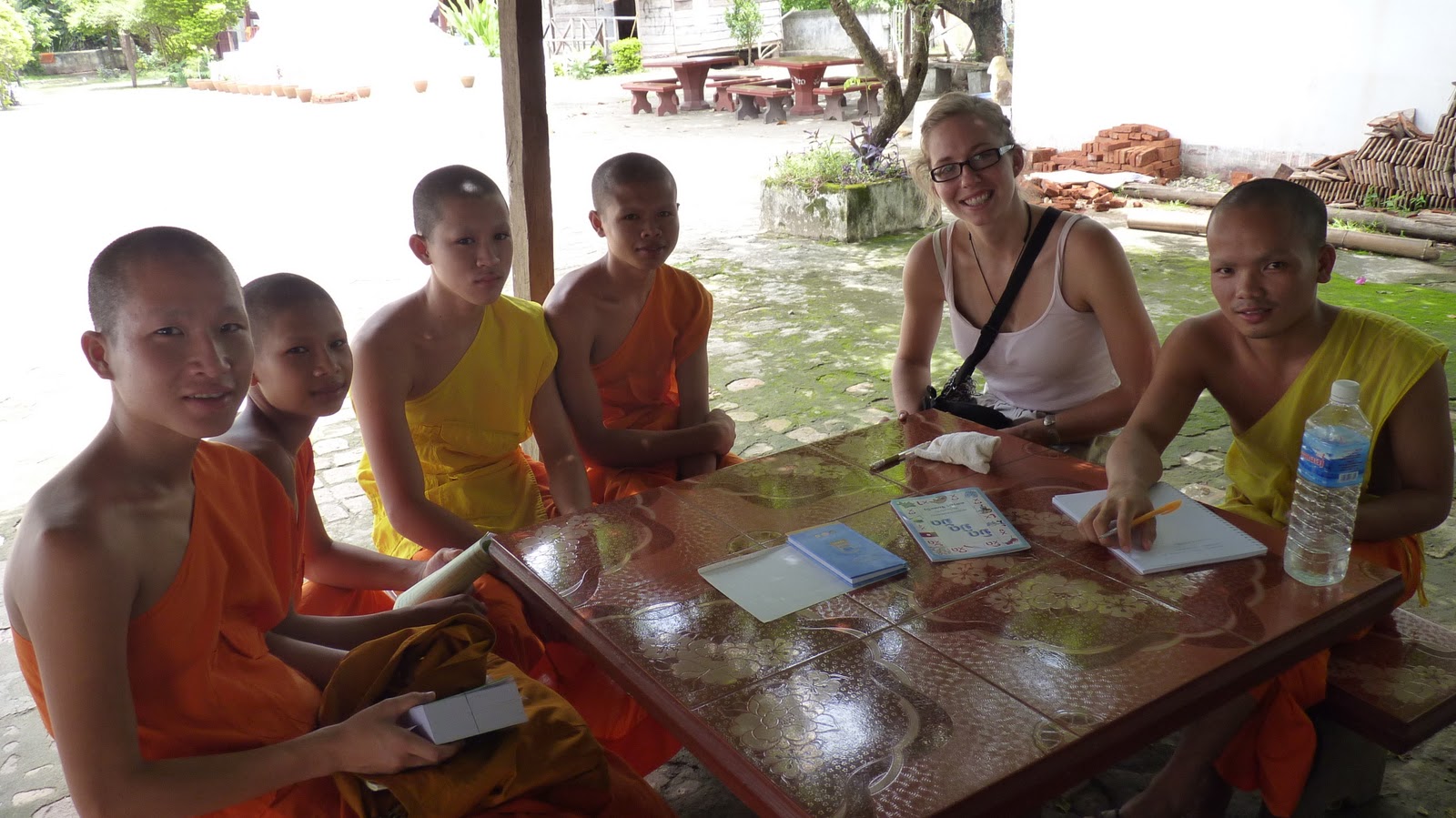
This morning we strolled into a wat, or Buddhist monastery, where a group of young monks and a European couple invited us to sit and practice English with them. We swapped words for trading cards for awhile, learning that several of the monks had come to the monastery at a very young age--fifteen for some. Although sending one child to the monastery is customary for Lao families, I was astonished at the journey these monks--kids, really--had taken. Several were from villages a few hours' bus ride away, which in the Western world is nothing more than a slightly lengthy trip to the local Ikea. But for these young men, life in Luang Prabang is a world away from these tiny mountain villages, from which most of their families will never leave and to where they return but a handful of times. Talking with them, it dawns on me how utterly relative distance is when traveling. I'm reminded of a line from a favorite poem, "The distance is deeper in my heart than miles can show" and just how far away even a blocks can be when something separates you from the people you love. 

Of course, technology can shrink distance...a lesson the monks apparently have learned as well, given they asked me for my name and email so they could "Facebook me." Guess I'd better be a bit more careful about which pictures to post... 

Sunday, August 15, 2010

laos part one: a banner year, a splendid day

        Here I am in Luang Prabang, about the celebrate the quarter-century mark with Ana, a Costa Rican girl I’ve only known a few weeks. I think it’s telling, the difference between my 24th and 25th birthdays. Last year, I was sitting around a make-shift bonfire at Lake Erie with my two best friends and our long-term boyfriends. We drank wine and played the kind of games you can only play when you’ve known each other for years; when you love each other like family. This year, I’m alone in Southeast Asia, gallivanting around places I’ve never heard of, riding elephants and drinking laolao, the local whiskey, with near strangers.
                I may not be writing with glee at the moment, and quite frankly, knowing my perpetually (and hopelessly) romantic soul, may not until I make the inevitable mistake of falling in love again. But for the first time in a very long time, I am content. Perhaps my newfound sense of calm has a little—or a lot—to do with the fact that I am in Laos, a country of pristine mountains, gentle people, and Theravada Buddhism. This particular brand of Buddhism stresses three principle aspects of existence: dukkha (suffering, unsastifactoriness, disease), annica (impermanence, transience of all things), and annatta (non-substantiality or non-essentiality of reality; the idea that there is no permanent soul). Understanding annica reveals that no experience, no state of mind, no physical object lasts. Both joy and pain dissipate, and it is trying to hold onto these things—experiences, objects, people—that are constantly changing that creates dukkha. Anatta is the understanding that there is no apart of this ever-changing world that we can point to and declare, “This is me” or “This is God,” or “This is the soul.” The point of all of this is simple yet glorious: nibbana, or the extinction of all causes of pain and suffering.
                It seems to me that the majority of my suffering has been a result of my inability to embrace annica. The transient nature of my life has left me lost and reeling in confusion. It dawns on me that although I feel so far from everyone here, even when I am “at home” I am still apart from those whom I love most. The realization hits me like a sack of bricks: I have grown to love New Haven, my life, my friends there—and yet, a year from now I may be across the country, never to see most of these people or places I treasure again. “I’ve lost two cities, lovely ones,” Bishop once wrote—and it’s hard not to sink into a self-pitying cocoon once you start thinking that way, missing people, missing things. Loving and embracing each experience and person in that very moment—appreciating its beauty in the present, and then letting it go; this practice is my goal for my 25th year. As one Buddhist monk pointed out profoundly, “Patience is a practice. The only way to cultivate it is to remind yourself constantly that the only place your life is occurring is every moment.”
                Even though I feel slightly treacherous for saying so, Luang Prabang is a refreshing change from China. While more expensive, the city’s calm nature, cleanliness, French-style architecture and Western-syle toilets are all a welcome change from the restless, vibrant, filthy Kunming. The people are friendly and sweet: brightly colored tuk tuk drivers line the streets, inquiring, “Where are you going, miss?” (The answer to which, of course, I do not know on so many levels.) Sandwich stands and pancake makers beckon from the sidewalks with their tantalizing smells and smiling faces. Monks, clad in simple orange robes, pace the dusty streets at dawn, moving silently and peacefully along each of the two rivers that ensconce the city. I think I’m going to like it here.

Friday, June 18, 2010

the hills are alive....

After finishing data collection last week, a bunch of us decided to get out of the city for a few days and head
to Jian Shui, a small city in southern Yunnan, followed by theYuanyang rice terraces.

Now, I’m no stranger to traveling on a budget. I’m a grad student, I’m poor—I’ve learned not to expect much from my accommodations. Or so I thought. On Sunday night, my roommate and I took a bumpy busride to Jian Shui to meet the rest of our friends. We showed up at the hotel, which compensated for its namelessness with holographic wallpaper and disco music. The first room we went to was filthy: skid-mark wall stains, cigarette-burned comforters, and more mosquitoes than I’ve ever seen in a natural environment. We decided to check out a second room. Room#2 was slightly cleaner, but the clouds of smoke hovering above the beds were less than appetizing. We entered Room #3 to find it was already occupied—by a cockroach. Shit. Choosing between which insect with whom I would sleep is not a dilemma I thought I’d ever face. But, it was late and we were tired, so we rationalized: a roach in one, a roach in all. So we climbed into bed, praying for no bedbugs, and turned off the lights. Two seconds later, Hila turned the lights back on. Bad move: roaches scattered across the floor like shy kids on the dance floor.

After a relatively sleepless night, we woke up and explored the town. Jian Shui’s a neat little city, composed mostly of alleyways, shops, and tiny restaurants. Most of these places have only a table or two; eating in one is like sitting in someone’s kitchen while they prepare the food a few feet away. The food is always fresh, usually from the market just a few hours prior, and usually quite tasty: rice with stir-fried eggs, tomatoes, or vegetables with plenty of la jiao, a searing spice I dump on everything. The specialty in Jian Shui is cho dofu, or literally, “stinky tofu.” The place reeks of the stuff; I never knew beans could smell so bad. ‘Course, most dishes apparently arrive with a side of bacteria, which now have taken up residence inside my GI tract. I’m pretty sure a small Chinese dragon has been chilling in my gut for a few weeks now. Everyone here’s some stage of sick though, so you learn to get over it and keep on movin’.
One bus, one van, and one taxi ride later, we made it to the rice terraces in Yuanyang. Truly, these mountains and villages and people are indescribable. The terraces are over 2000 years old, and in many ways it seems as though not much has changed. The villages that pepper the mountainside are home to several of Yunnan’s ethnic minorities. The women wear these brightly colored headdresses and carry woven baskets full of fruits and vegetables as they trek over the mountains to the market. Food is so central to life here: harvesting it, finding it, eating it. Pigs, cows, and roosters roam everywhere; they are slaughtered and cooked right on the cobblestone streets. The couple whose home we stayed in cooked for us each day—vegetarian, per request. Never have simple greens and rice tasted so delicious.

We encountered one couple on the top of the mountain on their way home to celebrate the Dragon Boat Festival. The man was carrying a live hen upside down in one hand; the woman had a giant basket full of leechy fruit and other goods strapped to her back. The irony of this situation is that we were all dressed to hike: backpacks, boots, snacks. The woman? She was carrying an oversized bedazzled handbag and was wearing heels. High heels on a mountain! Never again will I complain about uncomfortable footwear, that’s for sure. Later, we were treated to an impromptu concert on a cliff when a group of men, also returning home, stopped to play their recorders for us. There’s truly nothing like the sound of music with villagers and cows and roosters on a cliff overlooking ancient farmland.

We had great weather during the day, but the nights were chilly and rainy. Even so, I hiked alone to the overlook one evening to watch the fog reach its cold grey fingers down the mountains. Never have I seen something so haunting and beautiful. The next morning, we got up before the sun to watch it rise over the paddies. With the wind rippling through the rice and the clouds swirling around us, we watched in silence as the sun rose and crested over the peaks. Breathtaking.

So yes, I slept on dirty cots with Mickey Mouse comforters and cigarette burns. I shared a room with a small army of cockroaches. I got violently ill while standing inside a cloud. I took more than one shower literally standing on top of the toilet. But it was worth it. Incredibly worth it.


Kind of pretty, I suppose...

Might have had a lil' Sound of Music moment at the top....


The world's cutest kid....until you notice HE'S GOT A GUN! 


Saturday, May 29, 2010

pickin' flowers

My research is not taking as much time as I thought, leaving me restless and wandering most of the day. My whole life, I’ve dealt with problems by pouring myself into sports or school or work , as if achieving the next big thing will help me achieve peace—or revenge—or whatever it is I seem to be seeking. It doesn’t. In fact, it never does. And as I’ve learned this year, running away does nothing for assuaging anxiety either: first Chicago, then Charlotte, Seattle, Georgia, Costa Rica, and now China. The problems are the same; only the landscape changes.

And here I’ve been given this gift—this incredible summer of time- and I can’t sit still long enough to enjoy it. So I walk. I walk for hours, meandering through the streets, getting lost, getting un-lost, and getting lost again. I buy stinky candies in small shops and honey from street vendors and cheap plastic flip-flops in the Chinese Wal-mart. I sit in cafes. I sit in restaurants. I sit on a sunny bench next to the lily-padded pond. I take bad photos of sunflowers and willow trees. I read. I talk to myself. I talk to strangers. They rarely understand me. I walk some more.

Today’s excursion led me to what was advertised as an English “bookstore.” Turns out, it’s just a bookshelf full of used books tucked in the back of a restaurant—a delightful little secret. I adore used books, and discovering this little sun-lit, glass-ceilinged room was like discovering a hidden treasure. I sat there for hours, curled up alone on the little couch, reading Pollyanna and rediscovering Peter Hessler, who led me to China in the first place.

Eventually, it started to pour. The rain blew in, spraying me and my piles of books with a gentle mist. I’d forgotten about that 12-year-old spitfire, Pollyanna, namesake of the “Pollyanna principle” as well as "pollyanna-ish," an adjective describing people who always find something to be “glad” about regardless of the circumstances. The term is sometimes used pejoratively to describe people whose excessive optimism leads to naivete. As someone who was once described as “relentlessly optimistic,” I’ve wondered about that tendency myself and my ability to move on; I’m not always sure such optimism is a help so much as a hindrance. Spending most of your life with your head in the clouds means that sometimes you can’t read the warning signs on the ground, I’ve learned the hard way

But reading Pollyanna was like getting reacquainted with a childhood friend: refreshing and wonderful. Tucked away in this secret little bookshop in China, rain billowing from all sides, I found such joy. If my Pollyanna proclivity is the source of my anxiety and restlessness, than I suppose that’s okay. As another childhood favorite once said:

"I will be the gladdest thing under the sun! I will touch a hundred flowers and not pick one!" (Edna St. Vincent Millay)

Note: said rain is a product of “cloud-seeding,” or the Chinese government’s attempt to end droughts by injecting the sky with sodium iodide and dry ice…only a lil’ creepy, no?

Wednesday, May 26, 2010

dance like...the chairman is watching?

I’ve been dancing. There’s this Swedish art gallery/cafĂ© downtown where many of my girlfriends take class on Wednesday nights. Most of them are talented, and I watch with envy as the music transforms their lithe bodies. I am not. I haven’t taken a dance class since third grade, when I gave up on ballet because, although the shoes were pretty, my pathetic attempts at a pirouette were not. I am heinously uncoordinated, and have almost no memory for dance steps. Luckily for me, this class is more of a modern/freestyle class, and there’s no scary instructor giving me the evil eye as I topple over time and time again. In China, I’ve been making a concerted effort to do things that I’m terrible at: if not here, then where? I am awkard and ungaingly.But increasingly, I am okay with that.

Yesterday’s class was an experience I won’t forget. We gathered in the studio around 7:00, this group of girls who share little in common except temporary residence in Kunming and a flare for movement. Though, there’s something about people who live in foreign places, I’ve realized. Perhaps by virtue of choosing to leave their lives and move halfway around the world, most everyone I’ve met has been warm and welcoming. They almost always have an interesting story: how did you get here? No one has the same answer, and many of these tales are far richer and wonderful than something I could ever create. In any case, these girls have taken me in, despite my paltry Chinese, utter uncoordination…and, at best, unsavory appearance.

See, we dance barefoot. My feet, unfortunately, are absolutely hideous. First of all, Kunming is a dirty city, and we’re forever weaving our way through grimy alleys and leaping over puddles. Secondly, the Chinese have tiny feet. In an attempt to prevent the layer of dirt that has sprouted over my feet like a second skin, I decided to purchase a pair of sneakers. They’re cheap here, and shoe stores abundant, so no big deal I thought. Wrong. As it turns out, very few stores carry my size (an 8 in the States, nothing unusual), and when I ask for my size in women’s shoes, the clerks usually laugh uproariously and steer me towards the men’s section. The other day, however, I discovered a pair of cute purple Converse for about 60 RMB, or about $10 USD—a steal, I thought. But of course, they only have the shoes in a size 7. Tired of the dirt, and also of feeling enormous, I decided to buy them anyway. Wrong move. This is not the first time I’ve gone to war with a pair of shoes—like any woman, I’ve spent weeks battling precarious stilettos or unrelenting sandals. But these Converse are made of rubber, and after wearing them for one day, I limped home from Chinese class certain that their purple canvass would be stained red from the bloody stumps that were now attached to my ankles. So anyway, I show up to class with no fewer than five Band-aids on each foot, already dismissing any illusion of grace I might have conjured.

But we danced for hours, and as the night wore on, I was able to forget more and more the inhibitions that weigh so heavily: the foot wounds, my clumsiness, the perpetual anxiety that’s wracked my brain and body since early last September. After a few hours, a few friends joined us. They wheeled out a piano, some bongos, and someone brought a saxophone. As their music filled the gallery, we danced- both sound and music improvised to some unspoken theme. Dancing on that light-filled stage, in a gallery filled with beautiful paintings of the Kunming skyline, giving and taking with friends I’ve known for two weeks and also a lifetime: catharsis. Suddenly, there’s nothing but me, and music, and movement.

Although, as it turns out, that’s not entirely true. Just below the stage, under a glass cover, lay a starkly white sculpture of an old, naked man, his disproportionately small penis glinting under the lights. The scene was eerily reminiscent of Sleeping Beauty: expectant somehow in his repose, I kept expecting someone to bend down, kiss him, and awaken him to the music. Yet, after class, reading the tag underneath the sculpture, I’m glad no one did. The man, as it turns out, was Chairman Mao. I left unsure of whether his strangely small man-parts were an artistic error or a comment on communism, but certain of one thing: though I finally learned to “dance like no one is watching” as the clichĂ© goes, often, in China, someone is.

Monday, May 24, 2010

raindrops keep fallin' on my head...

Or some kind of mysterious liquid, that is. For some reason, walking on the sidewalks here is an invitation to get splashed -- water, toothbrush juice, urine, who knows—falling from an unidentified location above. Also, Chinese babies pee in the streets—in fact, they have a hole cut out in their bottoms for easy access—so I have become wary of even the most innocuous looking puddles.

As it turns out, the Chinese find Westerners’ obsession with hygiene totally bizarre. Of course, this hygiene issue—or lack thereof—leads to some interesting, albeit sometimes disgusting, dining scenarios. For one thing, knives are nonexistent-chopsticks only- so people just grab large chunks of anything and cram them into their mouths. Since my chopstick use is mediocre at best—I’m way far too clumsy/shaky to get a good grasp on those things—I spill food everywhere (yes, more than usual). But it’s cool, because I’ve found that meals here frequently involve bits of rice and noodles flying everywhere as everyone eats in a flurry of chopsticks and chatter. Also, people use their chopsticks to eat common food: everything is shared, which as a public health student and the daughter of an infection control nurse, makes me secretly cringe with every bite. No one has a problem with bringing their bowl to their mouths and sucking up noodles or rice like a human Hoover. Also, subject is too personal or bizarre for conversation. This weekend, I was chatting with a biostatistician at the Chinese CDC, and he asked me friendly but strange questions like how much I “prioritized money.” This question, I’ve found is a common one, as all Chinese people seem to think Americans are loaded. When I told him I had a cat, he asked me if my cat had had “its genitalia removed;” we proceeded to have a five minute conversation about the pro’s and con’s of removing Victor’s junk. He segued right into a more philosophical realm with next question: “Are you a Christian?” (my response: uh…..)

Actually, much to my personal delight, I’ve been exploiting my so-called Christianity here. At home, where my Catholicism consists of little more than church attendance for the rare wedding, the memory of 12 years of hideous plaid jumpers, and a lingering sense of guilt, I can hardly claim the religion as my own. In China, I find myself employing my so-called faith to get out of things I don’t feel like doing. This works well with Chinese people or Westerners of the non-American variety, because they either don’t understand what Catholicism is (Chinese) or they are somewhat afraid of it (Europeans). The excuse is handy because of its versatility: I can use it to get out of eating meat, doing things on Sunday, or just about anything I like, as my recent encounter with one feisty Scot exemplifies. We were at a bar around closing time, when he invited me under dubious pretenses to share an after-hours hot pot. (dear family: FYI, hot pot is a type of food, not a type of illegal herb).

“I totally would, but it’s Saturday night, and I have to get up early for Church tomorrow. You know, the Catholic thing…” I said by way of explanation.

“Are all Catholic girls this difficult?” he asked, disgruntled.

“Only ones who are studying to become nuns,” I said, before grabbing my roomies and hailing a cab, laughing all the way out the door. My Israeli roommates, by the way, find my Catholic excuses hilarious—the next step is to get them to try it out.

I’ve also been telling a disproportionate number of nun stories lately, mostly to horrify my UK peers, who apparently view Catholicism as some sort of draconian torture. Of course I have to perpetuate this belief by regaling them with tales of the time Sr. Adele punished me for poor reading skills by pinching clothespins to my ears, bruising me for weeks, or how, every time an ambulance passed, Sr. Mary Norberta would pray that the victims were not Catholic. These stories are not only untrue, they’re stolen from Pat Conroy, who has a far more imaginative and distorted view of a Catholic childhood than do I. I’m not sure why I find this so amusing, when I should be grateful simply to have some undiluted English conversation. In fact, the tiny fraction of my soul which has been forever imprinted with twice-a-week Masses and endless confessionals recoils in horror—I know I’m gonna pay for this someday. But in the meantime, since I highly suspect that the Chinese are laughing at my own poor dining etiquette (in fact I know they are—I finally learned the word for chopsticks, and can hear them saying something about kuai zi as they stare and laugh), and the Israelis gab away in Hebrew, I’ll take my mischief where I can get it—even if I’m the only one laughing.