After finishing data collection last week, a bunch of us decided to get out of the city for a few days and head
to Jian Shui, a small city in southern Yunnan, followed by theYuanyang rice terraces.
to Jian Shui, a small city in southern Yunnan, followed by theYuanyang rice terraces.
Now, I’m no stranger to traveling on a budget. I’m a grad student, I’m poor—I’ve learned not to expect much from my accommodations. Or so I thought. On Sunday night, my roommate and I took a bumpy busride to Jian Shui to meet the rest of our friends. We showed up at the hotel, which compensated for its namelessness with holographic wallpaper and disco music. The first room we went to was filthy: skid-mark wall stains, cigarette-burned comforters, and more mosquitoes than I’ve ever seen in a natural environment. We decided to check out a second room. Room#2 was slightly cleaner, but the clouds of smoke hovering above the beds were less than appetizing. We entered Room #3 to find it was already occupied—by a cockroach. Shit. Choosing between which insect with whom I would sleep is not a dilemma I thought I’d ever face. But, it was late and we were tired, so we rationalized: a roach in one, a roach in all. So we climbed into bed, praying for no bedbugs, and turned off the lights. Two seconds later, Hila turned the lights back on. Bad move: roaches scattered across the floor like shy kids on the dance floor.
 After a relatively sleepless night, we woke up and explored the town. Jian Shui’s a neat little city, composed mostly of alleyways, shops, and tiny restaurants. Most of these places have only a table or two; eating in one is like sitting in someone’s kitchen while they prepare the food a few feet away. The food is always fresh, usually from the market just a few hours prior, and usually quite tasty: rice with stir-fried eggs, tomatoes, or vegetables with plenty of la jiao, a searing spice I dump on everything. The specialty in Jian Shui is cho dofu, or literally, “stinky tofu.” The place reeks of the stuff; I never knew beans could smell so bad. ‘Course, most dishes apparently arrive with a side of bacteria, which now have taken up residence inside my GI tract. I’m pretty sure a small Chinese dragon has been chilling in my gut for a few weeks now. Everyone here’s some stage of sick though, so you learn to get over it and keep on movin’.
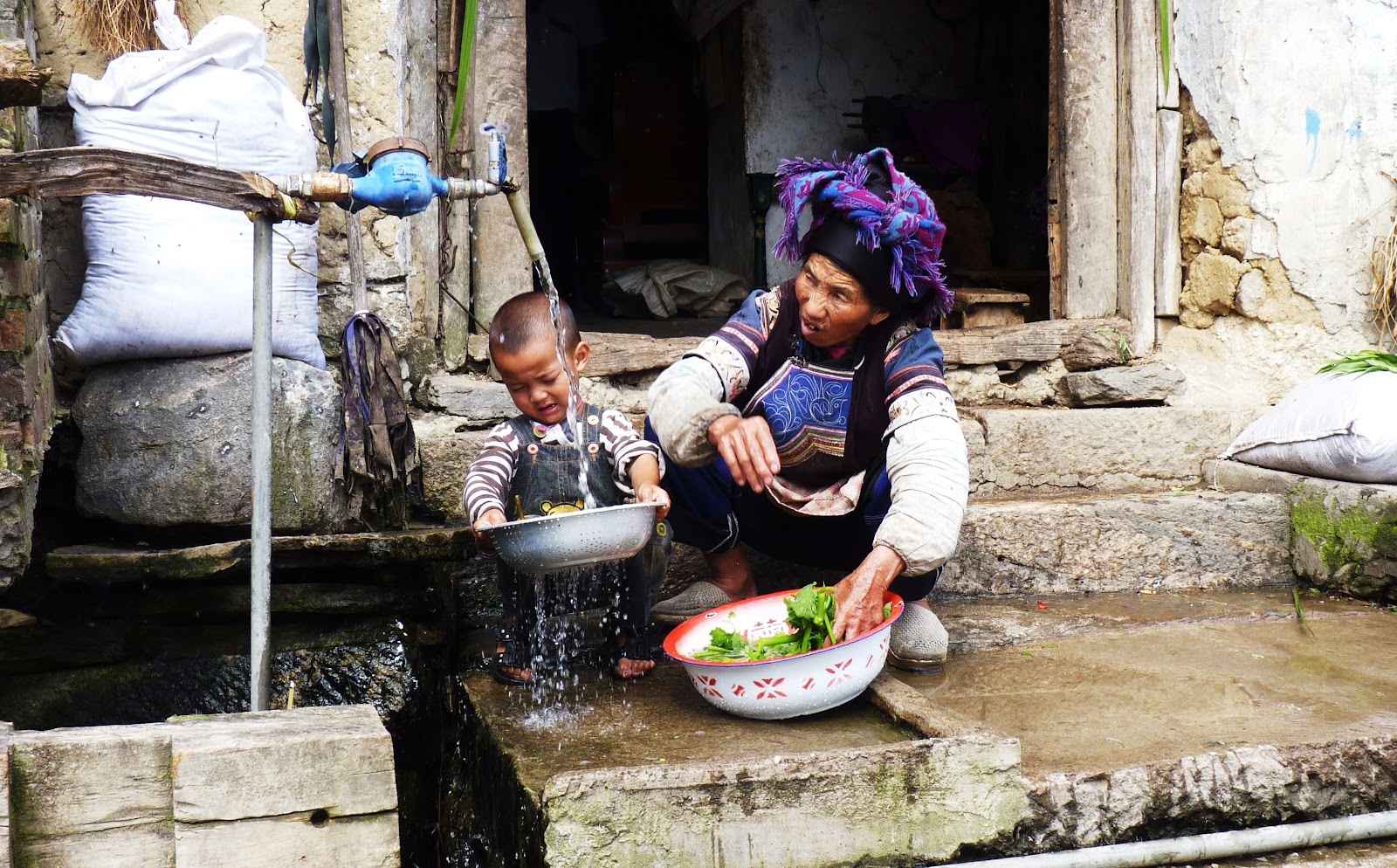
One bus, one van, and one taxi ride later, we made it to the rice terraces in Yuanyang. Truly, these mountains and villages and people are indescribable. The terraces are over 2000 years old, and in many ways it seems as though not much has changed. The villages that pepper the mountainside are home to several of Yunnan’s ethnic minorities. The women wear these brightly colored headdresses and carry woven baskets full of fruits and vegetables as they trek over the mountains to the market. Food is so central to life here: harvesting it, finding it, eating it. Pigs, cows, and roosters roam everywhere; they are slaughtered and cooked right on the cobblestone streets. The couple whose home we stayed in cooked for us each day—vegetarian, per request. Never have simple greens and rice tasted so delicious.
 We encountered one couple on the top of the mountain on their way home to celebrate the Dragon Boat Festival. The man was carrying a live hen upside down in one hand; the woman had a giant basket full of leechy fruit and other goods strapped to her back. The irony of this situation is that we were all dressed to hike: backpacks, boots, snacks. The woman? She was carrying an oversized bedazzled handbag and was wearing heels. High heels on a mountain! Never again will I complain about uncomfortable footwear, that’s for sure. Later, we were treated to an impromptu concert on a cliff when a group of men, also returning home, stopped to play their recorders for us. There’s truly nothing like the sound of music with villagers and cows and roosters on a cliff overlooking ancient farmland.
  We had great weather during the day, but the nights were chilly and rainy. Even so, I hiked alone to the overlook one evening to watch the fog reach its cold grey fingers down the mountains. Never have I seen something so haunting and beautiful. The next morning, we got up before the sun to watch it rise over the paddies. With the wind rippling through the rice and the clouds swirling around us, we watched in silence as the sun rose and crested over the peaks. Breathtaking.
 So yes, I slept on dirty cots with Mickey Mouse comforters and cigarette burns. I shared a room with a small army of cockroaches. I got violently ill while standing inside a cloud. I took more than one shower literally standing on top of the toilet. But it was worth it. Incredibly worth it.
Kind of pretty, I suppose...

Might have had a lil' Sound of Music moment at the top....

The world's cutest kid....until you notice HE'S GOT A GUN!


